Current Outfit. Is it legal? Help!!
Answers
-
@Lutz Well all I can say is that the Gov.uk (especially that one), The National Trailer and Towing Association, the CAMC, the Camping and Caravanning Club, Swift, Bailey Caravans (and all the other UK manufactures), Alko even, and numerous others including my tow car (KIA) and my other car have all got it wrong in their websites and manuals when they all say it is the combined weights (The gross train weight is the weight of the fully-loaded car plus fully-loaded trailer) and you are correct. No more to say really.
Really no more from me.
2 -
There's nothing wrong with the statement "The gross train weight is the weight of the fully-loaded car plus fully-loaded trailer" so long as one understands that even if the car is pulling the fully loaded caravan it isn't pulling its MTPLM but only its axle load. The difference, i.e. the noseweight, is not being pulled by the car but carried by it and therefore counts towards the car's overall weight. That's what makes the statement if not incorrect, but certainly very liable to misinterpretation. It's plainly poorly expressed.0
-
As I read that, you’re agreeing that Corners is correct 👍🏻
1 -
@Tinwheeler I really can't work it out. @Lutz is contradicting himself quite a bit.
The GTW (Gross Train Weight) is NOT the sum of the car's GVM (Gross Vehicle Mass) and the MTPLM of the caravan.
now: There's nothing wrong with the statement "The gross train weight is the weight of the fully-loaded car plus fully-loaded trailer" …
Who knows which it is, but I'll go along with all those websites.
1 -
Putting things another way, if you load the car right up to its maximum permissible GVW and then hitch the caravan, you would be overloading the car by the amount of the noseweight.
To arrive at the gross train weight after hitching a fully loaded trailer, the additional weight that makes up the total weight of the outfit, in other words its gross train weight, is not its MTPLM but only its axle load. It's still a fully loaded trailer, though.
A fully loaded trailer, i.e. one at its MTPLM, has two weight components, its axle load and the noseweight. The latter is transferred to the towing vehicle and counts toward the total weight of the towing vehicle. Only the axle load remains to be added to the towing vehicle's weight to arrive at the gross train weight.
Adding the MTPLM to the car’s maximum permissible GVW would not give you the total weight of the combination.1 -
Well, I reckon the OP must be bored silly by now, not to mention confused🙄
1 -
I apologise if I confused anybody, but I just wanted to prevent anyone from falling into the trap into falsely interpreting that the statement 'The gross train weight is the weight of the fully-loaded car plus fully-loaded trailer and must not be exceeded' means that gross train weight is the sum of the total weight of the car when hitched up to the caravan (as limited by its GVW), and the total weight of the caravan (as limited by its MTPLM). The consequences of such misinterpretation would be be quite substantial in the case of a fifth wheel combination where the gross train weight would be significantly less than the sum of both those values.0
-
You’ve just made it worse, Lutz.
1 -
I think you're totally right @Tinwheeler and for the OP don't count your spare tyre as a fifth wheel!
Only the axle load remains to be added to the towing vehicle's weight to arrive at the gross train weight. Not only confusing to someone starting out but impossible to know for most using caravans. I would say OP - @Amb832 just stick to the advice given about train weight being the sum (as given by Gov.uk and others ) and you'll be fine.
1 -
Imagine watching a discussion on this at the side of the road when the "possibly" offending outfit has been pulled over. It is nearly as exciting as seeing a long married couple putting a new awning up for the first time after an 8 hr drive.
Colin
0 -
I don't know what makes it so difficult to understand. Maybe things become clearer when one takes a 40 tonne truck as an example. The tractor unit will have a GVW of around 18 tonnes. A three axled trailer of an artic has an MTPLM typically of around 28 to 30 tonnes. Now 18 plus 28 is a lot more than 40, but the tractor unit is taking some of those 28 tonnes, so you see that you can't add the two together. Of course the figures for a car towing a caravan are a lot less but the same principle applies.1
-
Let's take pity on the poor OP who only asked about towing a caravan with a Tucson and give it a rest, shall we?
1 -
@Amb832 I checked my Kia Sorrento handbook online, It gives a Gross vehicle weight (I do wonder why if this term is obsolete why is it being used by so many manufactures?) of 2600 Kg. The gross vehicle train weight is given as 5100kg. Taking one from the other gives me a towable caravan up to 2500kg, which is stated as well for me in the handbook which is in line with all other official websites. Although that might not be a good match regarding kerb weight
It really is that simple. GTW - GVW.
However the max braked trailer weight is considerably lower if I had a hybrid, it is half that.
0 -
Cornersteady, you really are still failing to understand. Taking 2600kg from 5100kg does give you 2500kg, that's true, but 2500kg is not the maximum permissible total weight of the caravan. 2500kg is the maximum towable load and that is the axle load of the caravan, not its total weight. Please refrain from misleading the OP and everyone else.1
-
@Lutz I'm misleading, wow? I'm not as I'm merely reprinting what other organisations have printed, nothing more, including the main one which is Gov.uk. and doing my calculations from there. I could say the same to you about refraining from confusing people multiple times but I won't.
So the Gov.uk site is wrong? All those other numerous sites who say the same are wrong? But you're correct? I just can't get my head around that? All these printing something clearly incorrect according to you?
Are you going to write to our Government to correct their error? Are you going to write to KIA? Other manufactures? The National Towing and Trailer Association? The RAC? the two clubs? Why are so many organisations printing what is incorrect according to you and allowed to get away with it?
I'm not misleading anyone, I fail to see if you're corect how can KIA (note below - no mention of max towable load) get it so wrong and are allowed to print such errors and 'misleading' all their customers so blatantly?
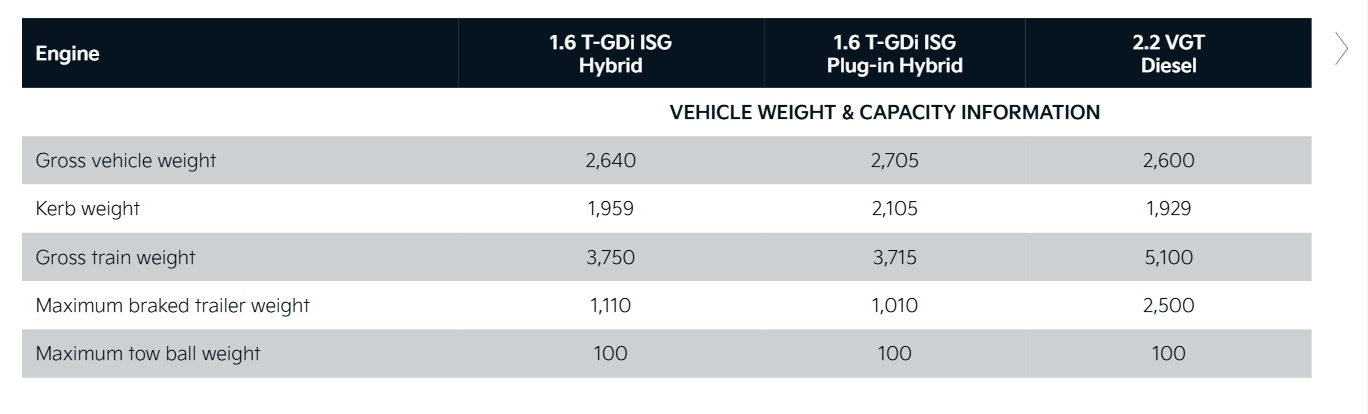 0
0 -
@Tinwheeler +1 , their proposed car will be able to tow that caravan weight.
0 -
The VW, yes. I think that’s a good move.
1 -
Cornersteady, there's nothing wrong with KIA's chart that you have quoted. It refers to the, quote, "maximum braked trailer weight". That is the axle load of the trailer because only the axles have any brakes. The noseweight, which is carried by the car but not towed, is braked by the car's own brakes. What's so difficult to understand about that? It doesn't say "maximum weight of a braked trailer". That would be something else. Then, and only then, would you be correct, but it would be contrary to the definition of towable mass which, for your benefit, I repeat here:
(9) ‘technically permissible maximum towable mass’ (TM) means the maximum mass of one or more trailers that may be towed by a towing vehicle which corresponds to the total load transmitted to the ground by the wheels of an axle or a group of axles on any trailer coupled to the towing vehicle;
These are not my words but a quote out of UK legislation.1 -
@Lutz , you are certainly misleading everyone there, quite dangerously in my view.
There are plenty of cars that have an unbraked trailer weight, the braked/unbraked merely refers to whether the trailer has brakes or not. The weight max weight is given by KIA as stated and really not open to any other interpretation in my view.
My Hyundai has a unbraked trailer weight of 450Kg v 800Kg braked. My Sorrento has an unbraked weight of (from memory) of 750Kg v 2500 Kg braked yet both could have the same noseweight. I think your analysis fails there in my view.
So I'm towing a caravan that is 2600Kg (for example which is somehow legal) and I'm pulled over by the police, they check the plate on the caravan and/or car details and they say that I'm 100 kg over. I'll reply but officer no you're incorrect as I've been told this by Lutz that 100Kg is being carried by the car so really I'm only towing 2500Kg and I'll show them that section (9) and they'll let me go on my way? Or perhaps I'll have to argue it out in court with a lawyer as knowledgeable as you. I'm not sure how that would end? It's academic as I really wouldn't get into this position and it's also rhetorical.
You appear to think that when you tow a caravan it is only the weights on the axle that you are actually towing, I disagree with that as the car is towing (pulling) all the extra weight that wouldn't be there if the caravan wasn't there, but you think what you want but another example:
People with driving licenses issued after 1997 can only tow up to 3500Kg,
You can tow a trailer that weighs up to 3,500kg MAM. This is known as a ‘category BE’ vehicle.
Now again if someone is caught with a trailer that is 3590Kg, could they use 'no, actually I'm towing 3500 and carrying 90Kg in the car through the nose weight, please see this quote from Lutz on the law'. I'm not sure the police would take your side on that. Again rhetorical (please).
But all that aside again I wonder why are so many learned and official websites are so wrong are you are right? Why are so many sites, can't really much higher than the Gov.uk are so misleading? Again this is rhetorical (please again).
Now really for the last time, I'll follow all those websites, government, club's various associations and my car manufactures sources while you're free to follow yours. May your way be as pleasant.
1 -
@Lutz While I was loading the caravan for it's towable load I realise that perhaps in these things you are using legal definitions as the one and only definitions. Well legal definitions are man made to help keep within the law and keep us safe. But (basic science 101) they are not always the definition as given in science and physics or mechanics. To paraphrase - science doesn't care about (your) legal definitions. Yes we need them, you had to use them but they are not perhaps the actual definitions in science?
That line of using legal definitions as real ones has in many cases held science back down the ages, I'm sure if a forum was in use there would be a good debate about 'of course Galileo should have tried, convicted and put under house arrest', after all the 'law' of the time said the earth was the centre of the universe. I know science is also theoretical and man made but the laws and theories appear to satisfy what actually happens which is good enough till something doesn't appear right.
So to finally end, you carry on with your views on legal definitions of towing and I'll do the same with what was taught to me for my degree and above. I've checked with a few Physics graduates and they haven't changed.
But as as the reasons given above about your changes of stance and others that's it and I'm going back to tow the full weight of my caravan by the car, sorry tow the towable load or whatever with my car. Depends on your point of view really. Now I'm sure you'll want some last words…
0 -
I've spoken to our Technical Manager at the Club who has advised the following. I hope this helps.
GTW is, in effect, an 'in use' assessment, not the combination of maximum figures for towing vehicle and trailer on their respective weight plates. For the caravan being considered, however (180kg payload), it's pretty likely that it will be used at or very close to its maximum weight (MTPLM), which is typical of most UK caravans. With very few exemptions (there are a few caravans with very generous payload allowances, usually European ones), it is not usually practical to make a caravan match a given car by loading it well below it's maximum weight
GVM is the maximum figure the towing vehicle can be loaded to. Even loaded for a holiday, you'll not usually reach this limit unless all the available seats are occupied with adults or larger children, but it needs to be kept an eye on.Both figures are legally significant - exceeding them could result in the vehicle or combination being considered to be unroadworthy. The easiest way to check you're within both limits is to take the loaded outfit to a weighbridge.
For a beginner, judging all of these things can be confusing. Good information is contained in the Club's Sites Directory & Handbook (for Club members) and pretty good advice is in the National Caravan Council's Caravan Towing Guide. Perhaps the best option, though (as suggested on the thread) is to phone the Club's Technical Advice line on 01342 336611 and talk it through with them. This service is open to Club members and non-members alike.
We hope this helps @Amb832 and let us know how you get on. 🙂
1 -
Thanks for that, but your link to the NCC Caravan towing guide states:
Gross Train Weight (GTW) The maximum permitted combined mass of the car and trailer as specified by the car manufacturer as stated on the car’s VIN plate. Usually the sum of the Gross Vehicle Weight and Towing Load limit.
which appears to contradict your technical manager? Who is correct
Also if GTW is Gross Train Weight (GTW) is legally significant how are we supposed to check it without going to a weighbridge? Add the two together perhaps?
0 -
I have no issue with the NCC caravan towing guide.
For the benefit of the OP and everyone else, I will summarise my previous posts in the simplest possible terms that I hope everyone will understand.
A fully laden caravan is at its MTPLM. I think we all agree on that.
The overall weight of the caravan on its own, whether empty, partially or fully laden at its MTPLM, has two elements. One is its axle load, the other is the load on the jockey wheel.
That load on the jockey wheel is transferred to the car when the caravan is hitched. It is then referred to as noseweight and counts towards the overall weight of the car. The remainder of the caravan's overall weight is its axle load and only that is being pulled by the car. When car manufacturers specify a towing limit, it will only refer to the load actually being pulled, in other words the axle load of the caravan, because its noseweight is already accounted for in the car's GVW and axle load limits. (Remember, the noseweight is being carried by the car, not pulled, so it doesn't count towards the towing limit).
In short, whether the caravan is fully laden at its MTPLM or not, the car isn't pulling the overall weight of the caravan. That doesn't mean that the rest, the noseweight, is simply ignored because it is already taken care of in the car's overall weight. In other words, a car which is fully laden right up to its GVW will be overweight by the amount of the noseweight when the caravan is hitched.
I do hope that makes things a bit clearer.1 -
Oh, and I forgot to add that the actual train weight is the total weight of the car and the caravan if both were to be on a weighbridge together, This value must not exceed the plated gross train weight limit.
If the caravan is hitched to the car, the train weight will be the sum of all axle loads. If car and caravan are on the weighbridge together but not hitched, it will be the actual weight of the car plus the actual weight of the caravan including what is on its jockey wheel.1 -
The MPTLM (Maximum Technically Approved Trailer Mass) is the fixed plated weight which states the maximum weight you can load your caravan, which is legally binding in use. The Nose weight of the caravan is included within the MPTLM (The actual nose weight will vary by user loading, up to the caravans manufactures maximum nose weight limit, also governed by the vehicles towbar weight limit)
The Nose weight cannot be deducted from the MPTLM of the caravan. As an example if your caravan is loaded to its plated MPTLM of 1500kg and your nose weight is 75kg then once hitched to the car this does not make your caravans mass 1425kg. It still remains at 1500kg
Road enforcement can weight your caravan on the road with measuring scales under each wheel. Obviously any nose weight will not be shown on axle measurements but they can also un hitch the caravan and measure the nose weight using the same scales, then by adding the three measurements together determine the total mass of the caravan, or they can request the caravan is weighed on their weighbridge for a more accurate reading.
The towing vehicle has a fixed weight plate. GVW (Gross Vehicle Weight KG) - GTW (Gross Train Weight KG) - Front Axle Weight KG - Rear Axle Weight KG . These weights must not be exceeded. The manufacturer will also have a recommended safe towing limit, this limit can be lower than the plated GTW (GTW minus the GVW) to protect the mechanical components and safety of the towing vehicle. In exceeding the manufactures recommended towing limits you may still be road legal but you could possibly invalidate any vehicle warranty or insurance. Note the manufactures max towing limit includes the nose weight of a trailer / caravan which is part of its total mass.
As above towing vehicle axles have their individual maximum weight. The axle weights added together can exceed the GVW but the GVW takes precedent, its still an offence to load an individual axle above its plated limit.
The nose weight (Downward weight on the tow bar) of a vehicle is legally governed by the plate fixed on the tow bar. For example it could state 100kg or 75kg. This must not be exceeded. Once the caravan is coupled to the towbar the nose weight then forms part of your tow vehicle's maximum rear axle weight, which in turn forms part of your GVW (Gross Vehicle Weight)
The towing vehicle GTW (Gross Train weight) is the maximum combined weight of a loaded trailer / caravan and its tow vehicle with fuel, driver, passengers or luggage. The GTW is usually measured with the car and caravan coupled together on a weighbridge.
0